When should my child see an orthodontist? The short answer is by age 7. That first check-up is quick, friendly, and free at Straight Smiles Orthodontics, and it tells you exactly where your child’s smile stands.
What Is an Early Orthodontic Evaluation?
An early orthodontic evaluation is a check-up that maps how your child’s teeth, jaws, and bite are developing. The American Association of Orthodontists recommends this first visit by age 7, when the first permanent molars and front teeth have usually come in and bite problems become visible. An evaluation is not a commitment to braces.
Why age 7? Because that’s the point where a braces expert can see how the upper and lower teeth meet, how much room exists for the teeth still on the way, and whether the jaws are growing in balance. Before that, there simply isn’t enough information. After that, some growth-related opportunities start to close.
Most children who come in at age 7 leave without any appliances at all. They’re placed on a growth-monitoring schedule so we can watch development and step in only if and when it helps. So when parents ask when their child should see a braces expert, the honest answer is that the visit is about information first and treatment second, and for the majority of families that distinction is a relief.
A few terms you’ll hear during the visit:
- Crowding: not enough space in the jaw for teeth to come in straight.
- Crossbite: upper teeth sitting inside the lower teeth instead of outside them.
- Overjet: upper front teeth that stick out horizontally past the lower front teeth.
- Underbite: lower teeth that sit ahead of the upper teeth when biting down.
- Mixed dentition: the stage when baby teeth and permanent teeth are both present, usually ages 6 to 12.
Dr. Nicholas Rafaill, Dr. Thomas Rafaill, and the team at Straight Smiles Orthodontics offer free consults for children, teens, and adults, so finding out costs you nothing but a little time.
What Happens at Your Child’s First Orthodontist Appointment
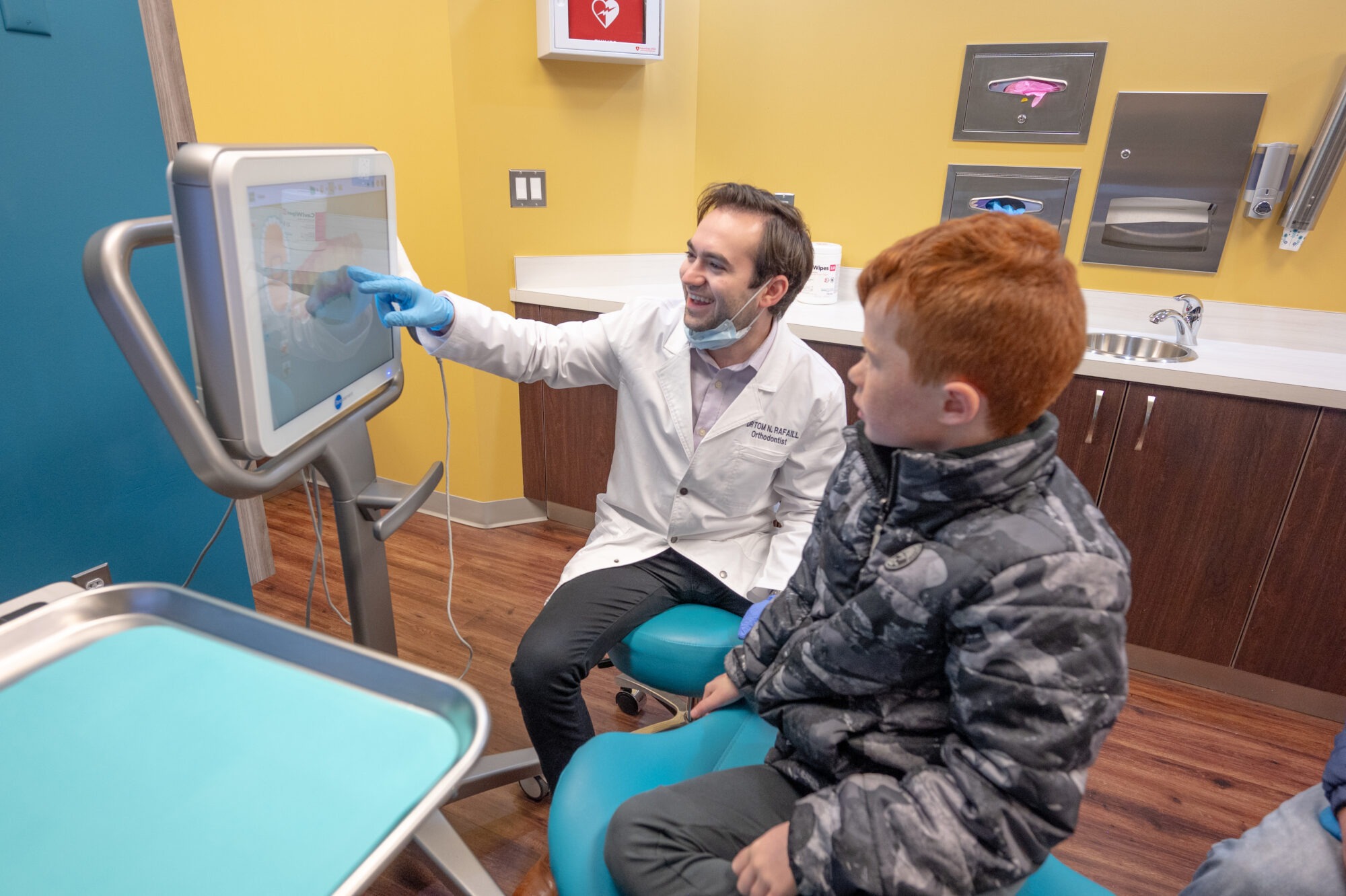
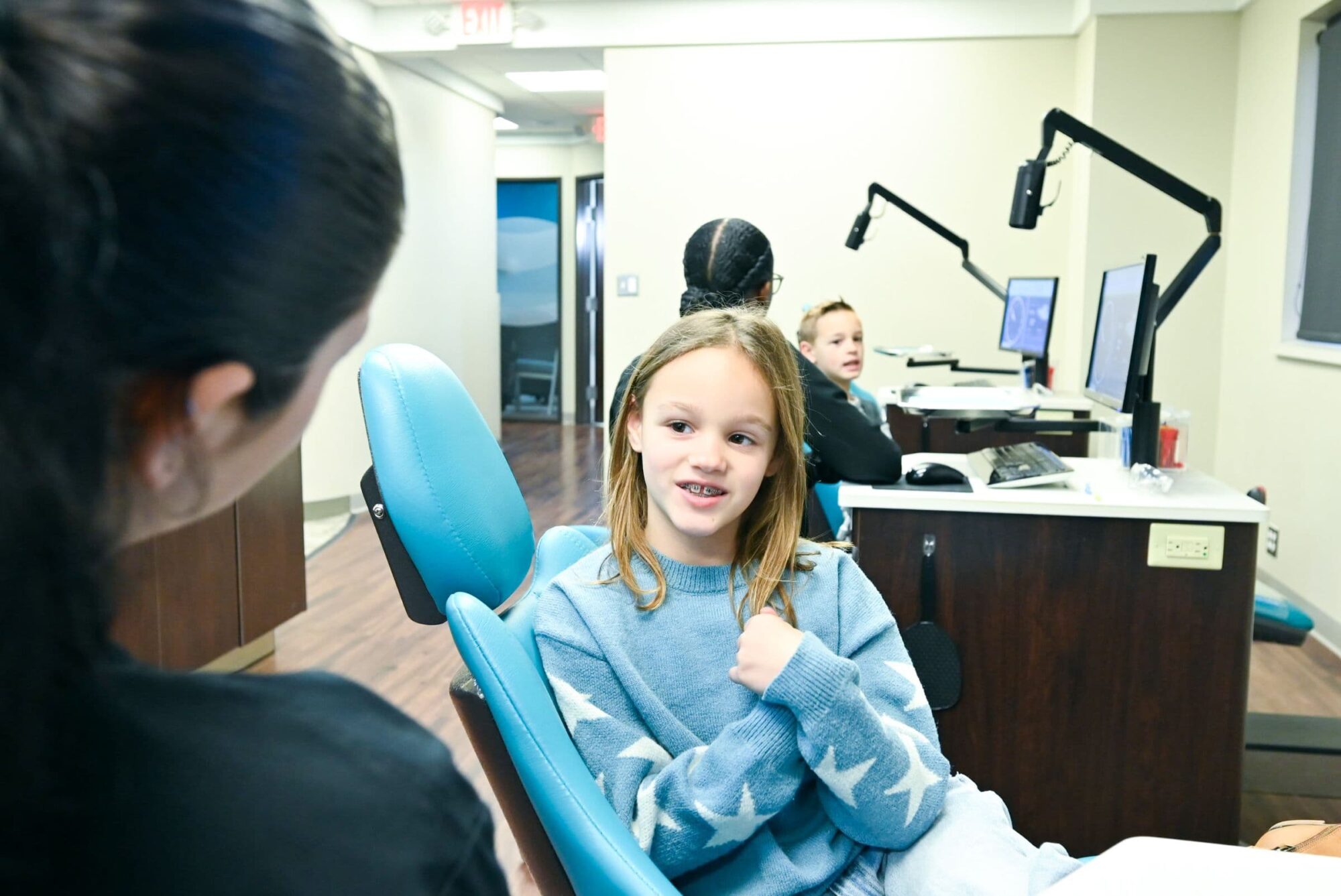
A first orthodontic visit in our practice typically lasts 30 to 60 minutes and involves no drilling, no needles, and no discomfort. Your child’s braces expert reviews health history, examines the teeth and jaws, and takes digital scans or images as needed. Then you’ll hear the findings in plain language, along with a recommendation to monitor or to treat. You’ll leave with answers the same day.
Here’s how the visit unfolds:
- Health and dental history review. We sit down with you first. Tell us about thumb sucking, mouth breathing, snoring, past dental work, injuries to the mouth, and any family history of crowding or jaw differences. Parents notice things charts never show.
- Clinical exam. Your child’s braces expert checks tooth eruption, spacing, bite relationships, jaw movement, gum health, and breathing habits. We look at how the jaws function together, not just how the front teeth look.
- Digital scans, photos, and X-rays as needed. Modern digital records replace the goopy trays of years past. Low-radiation panoramic X-rays show unerupted teeth, root position, and jaw structure, and we only take the images that actually inform the diagnosis.
- Diagnosis in plain language. We show you what we see on screen and explain it without jargon. If there’s a crossbite, you’ll see the crossbite. If everything looks great, you’ll hear that too.
- A clear recommendation. There are usually two outcomes: place your child on our complimentary growth-monitoring schedule, or begin treatment now because timing matters for that specific problem. If treatment is recommended, we walk through the plan and the timeline before you leave.
Kids leave these visits relaxed. Many are genuinely excited, especially once they see their own teeth on a big screen.
Benefits of Early Orthodontic Care for Children
Early orthodontic care guides jaw growth, creates space for permanent teeth, corrects habits such as thumb sucking, protects protruding front teeth from injury, and often shortens or simplifies teenage treatment. It also improves chewing and speech, and it supports a child’s confidence during the years when self-image is taking shape.
Early care works with growth instead of against it. While the jaws are still developing, gentle guidance can accomplish things that later become far more difficult. That’s the whole idea behind seeing a braces expert at age 7 rather than waiting until high school.
Early orthodontic care can:
- Guide jaw growth while the bones are still forming and responsive, which helps the upper and lower jaws develop in better proportion.
- Create room for permanent teeth to erupt in the right spot, often lowering the chance that teeth will need to be removed later.
- Correct harmful habits such as thumb sucking or tongue thrust before they reshape the bite and the roof of the mouth.
- Protect protruding front teeth from chips and fractures, since teeth that stick out are far more vulnerable during sports and playground falls.
- Shorten or simplify teenage treatment, because the hardest structural work is already done by the time the permanent teeth arrive.
- Improve chewing and speech, and give your child confidence during years when self-image is forming fast.
Why Is It Easier to Guide Growth Than to Correct It Later?
Bone in a growing child is still soft, active, and responsive, which means a well-designed appliance can encourage the upper jaw to widen or the lower jaw to come forward with very little force. Once growth slows in the mid-teens, that same correction usually calls for longer treatment, heavier mechanics, and occasionally a surgical option in adulthood. Guiding development while it is actively happening is nearly always the simpler path, and it explains why a braces expert wants to see your child before the growth window narrows. Regular monitoring also builds a record of how that growth is unfolding, visit by visit.
How Does Early Care Affect a Child’s Confidence?
Elementary and middle school years are when children begin comparing themselves to everyone around them, and teeth are one of the first things they notice. Confidence matters more than parents sometimes expect. A child who covers their mouth when they laugh carries that habit for years. Straight teeth mean having a beautiful, confident smile, and confidence at nine years old tends to stick around.
Not every child needs early treatment. The point of the evaluation is knowing the difference, and knowing it early enough that the choice is still yours.
Early Treatment (Phase 1) vs. Waiting Until All Adult Teeth Arrive
Most children need only one round of treatment. The early evaluation exists to determine which approach fits your child, and roughly when to start. Here’s how the two compare:
| Early Treatment (Phase 1) | Full Treatment (All Adult Teeth In) | |
|---|---|---|
| Typical age | 7 to 10 | 11 to 14 |
| Main goals | Guide jaw growth, correct crossbites, create space, stop harmful habits | Align the full set of permanent teeth and finish the bite |
| Common appliances | Palatal expanders, partial braces, space maintainers, habit appliances | Full braces, ceramic braces, almost-invisible braces |
| Typical duration | Usually 6 to 12 months, followed by monitoring | Usually 12 to 24 months |
| Best fit for | Skeletal differences, severe crowding, protruding front teeth, functional shifts | Mild to moderate crowding, spacing, and bite refinement |
The durations above are typical ranges drawn from clinical experience rather than fixed figures, and every case sits somewhere on that range.
Phase 1 tackles problems that get harder to fix once growth slows. A narrow upper jaw, for example, responds beautifully to an expander at age 8 and far less easily at 16. Same with a crossbite that forces the lower jaw to shift sideways every time your child bites down.
Waiting is often the right call. If your child has mild crowding, adequate jaw width, and a bite that functions well, there’s no reason to place appliances early. We simply watch development every 6 to 12 months and begin full treatment when the timing is ideal.
You and your smile are two of a kind, and so is your child’s. The recommendation always follows the individual case, never a formula.
Signs Your Child May Need an Orthodontic Visit Sooner
Some signs shouldn’t wait for the age 7 benchmark. If you notice any of the following, go ahead and schedule an evaluation:
- Baby teeth lost very early or very late, or permanent teeth erupting badly out of sequence.
- Crowded, blocked-out, or protruding front teeth, including teeth coming in behind or in front of others.
- Crossbite or underbite, where upper teeth close inside the lower teeth or the lower jaw sits forward.
- Difficulty chewing or biting.
- Mouth breathing, snoring, or restless sleep, which can relate to airway and jaw development and is worth mentioning at the visit even when it seems to have nothing to do with teeth.
- Thumb sucking or pacifier use past age 5, especially if the front teeth are already flaring outward.
- A jaw that shifts, clicks, or looks off-center.
- Speech difficulties that your child’s dentist or speech therapist links to tooth or jaw position.
Parents catch these things first. If something about your child’s bite has been nagging at you, that instinct is worth acting on, and a free consult is the easiest way to check.
Dr. Nicholas Rafaill, Dr. Thomas Rafaill, and the team at Straight Smiles Orthodontics see children, teens, and adults, and the doctor who examines your seven-year-old is the same doctor who will check that first retainer years later. Family-owned care keeps the record of your child’s growth in one set of hands, which matters a great deal when decisions depend on small changes tracked across several years. Extended hours are built around school and work schedules, so a short growth-monitoring visit rarely takes up an entire afternoon.
Frequently Asked Questions About Kids and Orthodontists
Does my child need a dentist referral to see an orthodontist?
No. Orthodontics is a dental specialty you can access directly, and you’re welcome to schedule an evaluation on your own. Many families come to us on a dentist’s recommendation, and many others simply call after noticing something themselves. Either way works.
Is age 7 too early for braces?
Age 7 is the right age for an evaluation, not necessarily for braces. The majority of 7-year-olds we see are placed on a monitoring schedule and come back periodically while we track growth. Treatment starts when it will do the most good, which for many children is several years later.
How long does Phase 1 treatment usually last?
In our clinical experience, Phase 1 typically runs about 6 to 12 months, depending on what’s being corrected. An expander, for instance, works actively for a few months and then stays in place to hold the new width while bone fills in. After Phase 1 ends, there’s usually a resting period while the remaining permanent teeth come in.
Will my child still need braces as a teen after early treatment?
Often, yes, though the second round is usually shorter and more straightforward. Phase 1 handles the structural work: jaw width, bite relationships, and space. Phase 2 aligns and finishes the full set of permanent teeth, and by then the hardest part is behind you.
Are X-rays at the first visit safe for children?
Yes. Digital orthodontic X-rays use a low dose of radiation, generally comparable to just a few days of the natural background radiation everyone is exposed to anyway, and we take only the images needed to make an accurate diagnosis. A single panoramic image and digital photos are often enough at a first visit. If your child had recent X-rays at their dentist, we can usually use those instead.
How often are growth-monitoring visits scheduled?
Usually every 6 to 12 months, depending on what we’re watching. These check-ins are complimentary at Straight Smiles Orthodontics and take just a few minutes. They exist so treatment begins at the ideal moment, not too early and not after an opportunity has passed.